The Wreck Explorer · North Sea collection
SS Malvina & UB-107 in 3D
A Leith steamer built on the Clyde in 1879 and a German submarine built at Hamburg in 1917 now lie together off Flamborough Head. Malvina was lost before dawn on 2 August 1918 with fourteen men. UB-107 was lost with all hands in late July or early August 1918. How either was lost, and whether the two losses are connected, has not been proved. This viewer shows what is documented, what archaeologists and divers have reported, and what has had to be interpreted.
What this 3D scene shows
Documented Measured survey Photograph Diver account Interpretation Artistic reconstruction Disputed
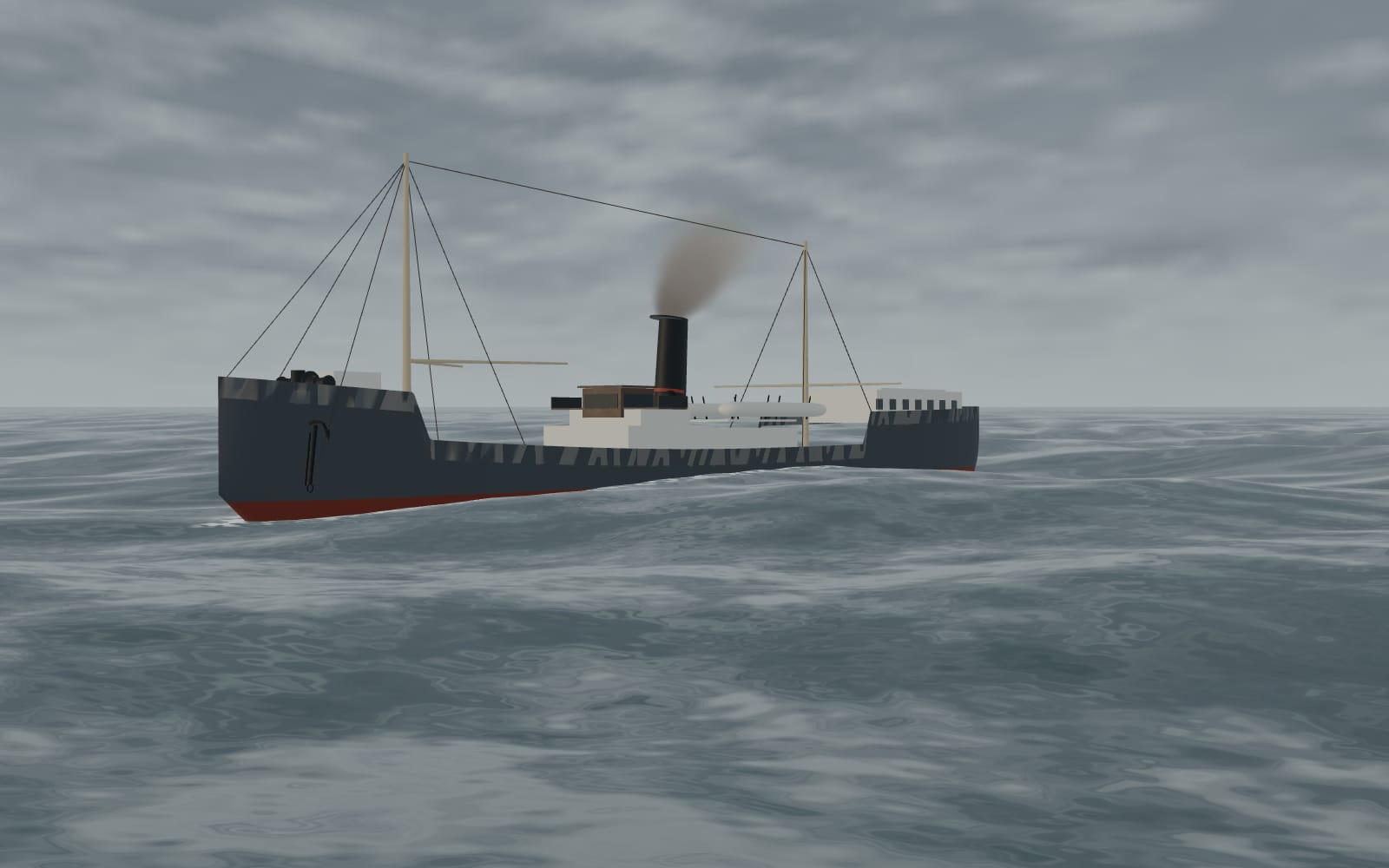
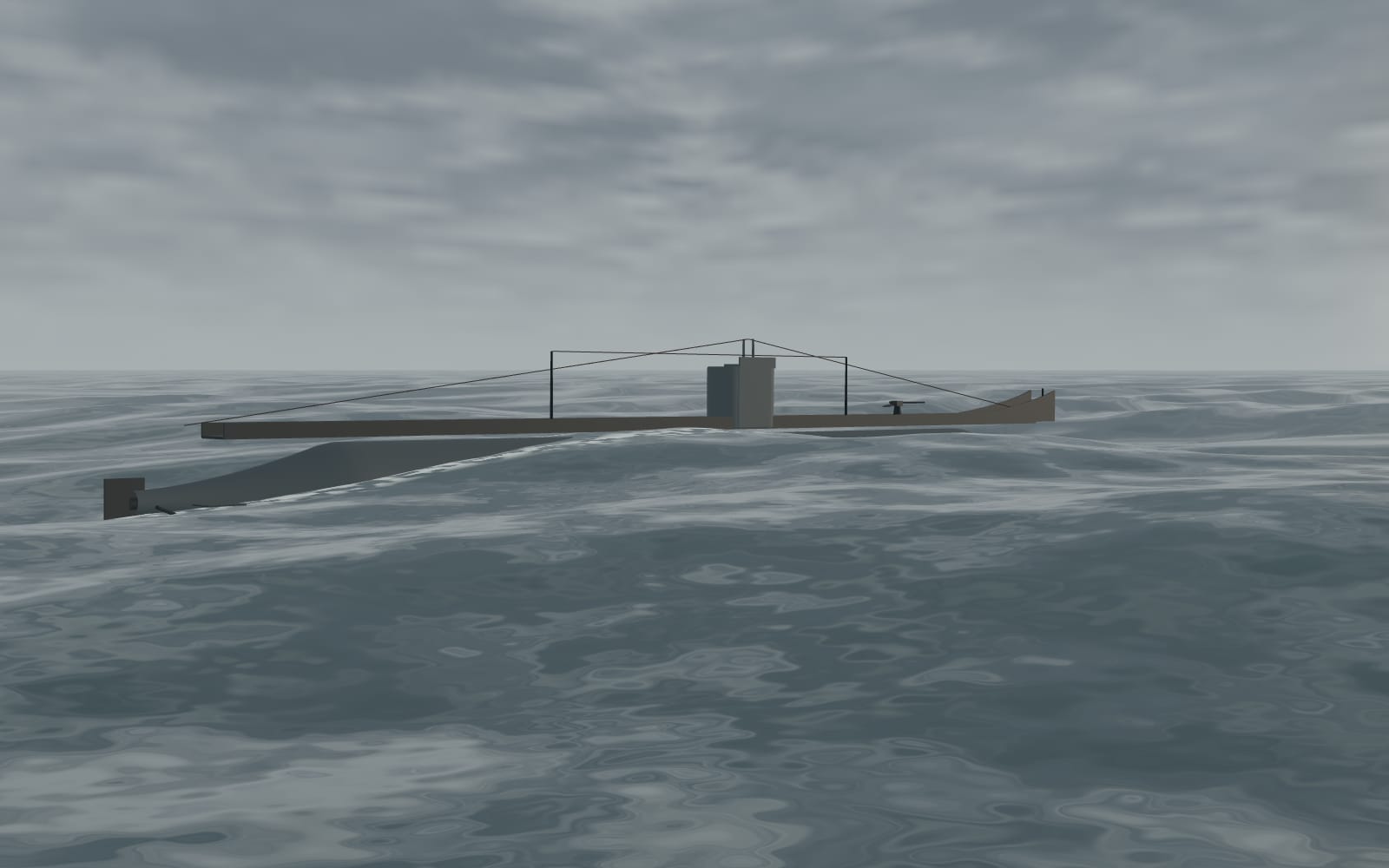
1879–1918 · Afloat: two ships
Malvina as the registry and two undated photographs suggest she looked: an iron screw steamer, 254 ft 4 in by 31 ft 2 in (77.5 by 9.5 m), with a raised forecastle and a long raised poop, one funnel amidships, a bridge house forward of it, two pole masts with derricks, and boats abaft the funnel. Her 1918 paint, her gun and her hatches are not recorded. UB-107 is a UB III submarine drawn from the class: her fittings are interpretation.
Bridge house and wheelhouse
Photograph, interpreted Details: interpretation
Photographs show the bridge on a deckhouse forward of the funnel, with an open rail bridge. Wheelhouse details, windows and colours are reconstruction.
One funnel, two cowls
Photograph, interpreted Colours: artistic
A single tall funnel stood amidships, with two large cowl ventilators forward of it. Her funnel colours are not known; black is drawn.
Raised poop and passenger house
Photograph, interpreted Layout: interpretation
She carried passengers as well as cargo. A long raised poop with a windowed deckhouse stands aft, with a second steering wheel at the stern. How many cabins it held is not known.
Pole masts and derricks
Photograph, interpreted Rigging: interpretation
Two pole masts, the foremast well forward with cargo derricks. The foremast flew the house flag. Sails, if any were carried in 1918, are not shown.
Forecastle and windlass
Photograph, interpreted Fittings: interpretation
A short raised forecastle with a windlass and anchors at the hawse. The windlass is a generic period pattern.
Engine and boilers
Engine documented Boilers: interpretation
A triple-expansion engine (cylinders of 25, 43 and 66½ in, stroke 48 in) by Ramage & Ferguson of Leith replaced her original compound engine in 1896. Divers report two boilers. Their type, size and furnaces are not documented.
Conning tower and periscopes
Class documented Shape: interpretation
UB III boats carried a rounded conning tower amidships with periscopes and two folding radio masts. UB-107’s own tower is described only as fallen in two halves; its original shape follows the class and photographs of her sister UB-110.
The 8.8 cm gun
Published record Position: interpretation
The class carried one 8.8 cm deck gun on the forward casing, ahead of the tower. The gun is missing from the wreck; the survey suggests it may have been blown off its mounting.
2 August 1918 · The loss
At about 04:15, bound from London to Leith with general cargo, Malvina was struck on her starboard side. The Admiralty casualty report records a torpedo hit and says she “buckled” and sank within three minutes. Her Chief Officer was certain she had been torpedoed, though he saw no torpedo or track. The trawler Gaul, half a mile away, picked up survivors. Fourteen men died. A mine remains possible: the war channel off Flamborough had been closed the day before because of loose mines. The scrubber shows only this: a brief flash, her hull buckling, and her sinking. No weapon, wake or attacker is shown, because what sank her has not been proved. UB-107’s loss is not shown: when and how she was lost is not known.
Historic England’s published assessment tested the explanations offered for UB-107’s loss: a mine, a torpedo fired at Malvina and a collision in the dark, UB-107 running into the already-sunken wreck, and damage off Scarborough followed by a drift south. It concludes that none is convincingly evidenced, and that there is insufficient evidence to prove how the submarine was lost and whether its loss was connected to the loss of Malvina.
Today · The wreck site
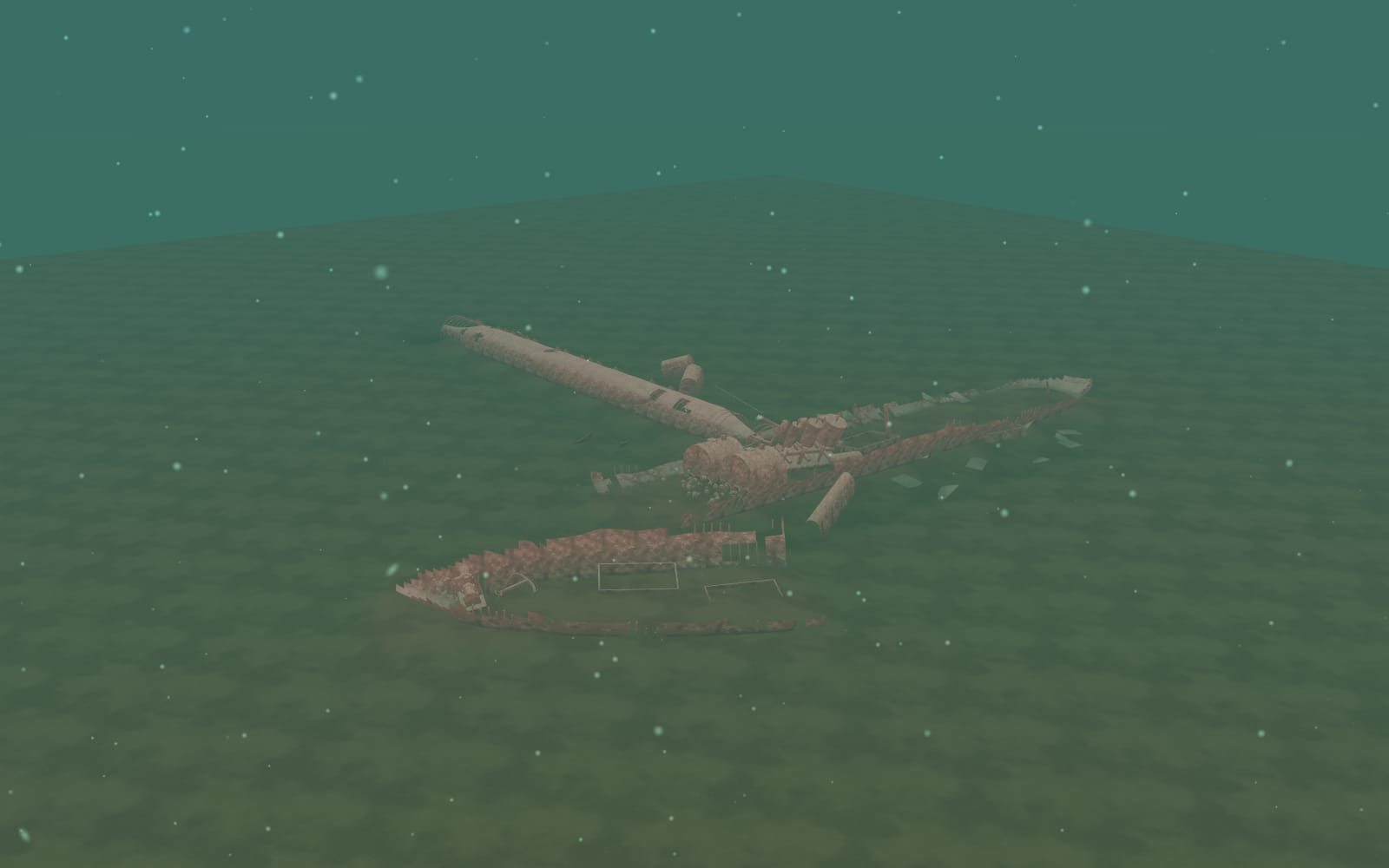
Archaeological survey confirms that the two wrecks are in physical contact, with UB-107 lying partly under Malvina’s wreckage. UB-107 lies on her starboard side at about 45 degrees; Malvina is in two parts. The survey’s multibeam images are not reproduced here. Wreck lengths, heights and scour were not available from any source we could reach, so everything below is an interpretation built to match the published descriptions.
Malvina’s main part
Two parts: survey image Profile: interpretation
A low, collapsed iron hull with its plating torn and its frames showing. The survey image shows the ship split in two. How high the wreckage stands is not recorded.
Two boilers
Diver account Size and type: interpretation
A diver guide describes the engines “tilted over behind two boilers”. Two single-ended boilers are drawn, side by side, with one furnace door hanging open.
The tilted engine
Diver account State: interpretation
The triple-expansion engine, leaning over behind the boilers as the guide describes. Its condition is drawn as collapsed and silted.
Malvina’s fore part
Separated part: survey image Shape and place: interpretation
The survey image shows part of the ship lying away from the main wreckage. Where she broke, and how the fore part lies, are interpretation. The windlass, an anchor and the foremast are drawn fallen among the wreckage.
Where they touch
Contact: surveyed Which end touches: disputed
This updated wreck-site model is an interpretive reconstruction supplied for the project, not a survey or a navigational chart. The wrecks are reported to touch, but published accounts and descriptions of the submarine’s orientation conflict. This model shows one interpretive arrangement; it does not establish which end lies beneath Malvina. Explore the evidence and unresolved questions ↗
The hole forward of the gun mount
Survey and diver account Shape: interpretation
A large hole through part of the pressure-hull circumference, immediately forward of the gun mount, above where the forward battery compartment lay. Corrosion is active on its edges. No sign of the crew accommodation below can be seen.
The gun is missing
Survey and diver account
Only the mounting ring is drawn. The survey suggests the gun may have been blown off.
The conning tower, in two halves
Survey and diver account Where they lie: interpretation
The tower is no longer in place: it has fallen onto the seabed and lies in two halves. One periscope has been partly salvaged and the other is displaced. Where the halves lie here is interpretation.
An open stern
Survey and diver account Shape: interpretation
The pressure hull is open at the stern. In the 1980s both propellers and the stern torpedo tube were removed, reportedly with explosives. The port shaft survives; the starboard propeller was not seen.
The bow
Survey and diver account Shape: interpretation
The bow is also reported damaged and open. Its torpedo tubes, and whether torpedoes remain, are not recorded.
Loose wreckage
Diver account Positions: interpretation
Hydroplanes and rudders have come away from the stern; a rudder lies on the seabed in the debris. The aft radio mast has fallen onto the seabed. Deck planking has gone, leaving the stubs of the casing supports.
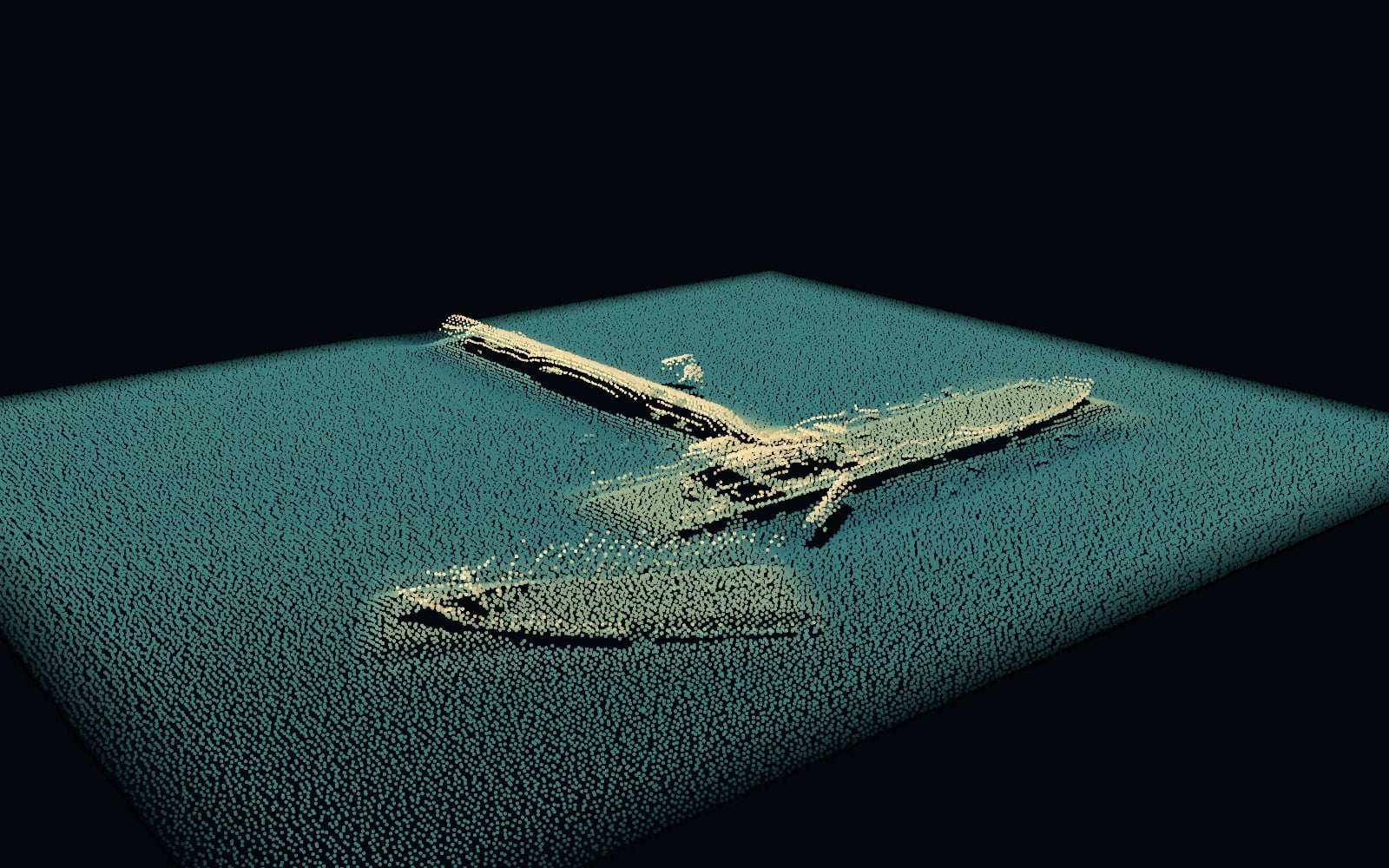
Sonar-style
A point cloud coloured by height, generated from this 3D interpretation so that the shape of the site can be read at a glance. It is not survey data, and no lengths, heights or depths of the wrecks were available, so none are shown. When it opens, the points scatter from the wreck and fly back into place while the camera moves through them; any tap, click or key skips this.
A protected place
UB-107 has been a protected place under the Protection of Military Remains Act 1986 since 2 September 2019 (the Protection of Military Remains Act 1986 (Designation of Vessels and Controlled Sites) Order 2019, re-made in 2026). It is not a controlled site, but disturbing or removing anything from her is an offence, and human remains are likely. Malvina is not designated, but her remains lie over the protected submarine. This page is not a dive guide and gives no position or depth: check the current designation and local guidance independently, and look, but do not touch.
Recorded dimensions
- Malvina: registered size
- 254 ft 4 in × 31 ft 2 in × 18 ft 3 in (77.5 × 9.5 × 5.6 m)
- Mercantile Navy List, 1915
- Malvina: tonnage
- 1,244 gross · 593 net (1915) (1,182 gross as built)
- Mercantile Navy List, 1915
- Malvina: numbers
- Official No. 79156 · signal letters SNLC · Leith
- Mercantile Navy List, 1915
- UB-107: class size
- 55.3 m overall · 5.8 m beam · pressure hull 40.1 × 3.9 m
- Published record (uboat.net; Wessex) Class figures, not measured on the wreck
- The wrecks today
- Not available: no wreck lengths, heights or scour were obtained
- Drawn as interpretation
Photographs and references

Also used as references, not reproduced: undated photographs of Malvina on the Caledonian Maritime Research Trust’s Scottish Built Ships database (reproduction needs permission); photographs of the UB III boat UB-110, the same builder’s batch as UB-107, held by Tyne & Wear Archives & Museums (Flickr Commons, “no known copyright restrictions”); and a photograph of a UB III scale model by AchimKoerver (CC BY-SA 3.0). There are no published underwater photographs or survey images of either wreck on this site.
Remember them
Two crews. Please treat both wrecks with respect.
Malvina, 2 August 1918
Thirteen of these names are in official records (the Tower Hill Memorial and the Royal Navy casualty list). Gilbert Gray appears only on the MaritimeQuest roll, and we have not been able to check him against an official record.
- Thomas Harris Master
- William Brock First Engineer
- Samuel Ferguson Third Engineer
- Benjamin Brown Steward
- Andrew R. S. McDonald Greaser
- Archibald Campbell Fireman
- Richard Imrie Fireman
- John F. McCombie Fireman
- Robert Mercer Fireman
- Michael Scullion Fireman
- Robert Graham Deck Boy, 17
- David B. R. Laing Deck Boy, 15
- Magnus Oakes Leading Seaman, RNR
- Gilbert Gray Able Seaman · listed by MaritimeQuest only
UB-107, lost with all hands
Her crew on her last patrol is given as 37 men by the archaeological report and 38 by other sources. The names below are the MaritimeQuest memorial transcription; spellings and numbers are as given there, and should be checked against original records.
- Heinrich Ackermann
- Eugen Alt
- Arthur Anlauf
- Georg Böhm
- Heinrich Brix
- Johannes Carstensen
- Wilhelm Damann
- Karl Diehl
- Ernst Diehn
- Albert Engel
- Josef Ewald
- Friedrich Fenkner
- Andreas Filaferra
- Fritz Folprecht
- Aldred Franz (source spelling)
- Wlater Fröhlich (source spelling)
- Paul Gäthje
- Karl Grüneberg
- Alfred Hartwich
- Georg Hilscher
- Hermann Kiessling
- August Krug
- Josef Kullenberg
- Gustav Maass
- Paul Müller
- Emil Pagel
- Erwin Pollednick
- Eberhard von Prittwitz und Gaffron — commanding officer
- Wolfgang H. Richter
- Max Schneider
- Paul Schrader
- Franz Schütze
- Heinrich Sippel
- Richard Sperling
- Hugo Tuhmann
- Richard Übel
- Fritz Viehweger
- Willy Wünsche
About this rendering
- Artistic choices (not evidence): weather, sea state and sky; the sun’s bearing; funnel smoke; paint and funnel colours of both vessels; light shafts and faint caustics underwater; the height and spread of the wreckage; the scour and the silt banked against both wrecks; where the loose wreckage lies; hull and upperworks details not in a source.
- How the wrecks lie follows the published survey description (contact, UB-107 at about 45 degrees on her starboard side, Malvina in two parts) and is otherwise an interpretation.
- Water. Real visibility at the site is not recorded here. Underwater clarity is a viewing choice and is labelled whenever it has been cleared for clarity.
- Diver torch is an exploration aid.
- Sonar-style view is generated from this model, not from survey data, and shows no measurements.
- No coordinates, bearings or depths are shown anywhere in the viewer or its saved images.
- Built with three.js r185 (MIT licence, below), with original procedural geometry and textures. No photogrammetry scan is used.
- The sea in the afloat and loss scenes is Ultra Water by Humpalumps (MIT licence, below), a real-time ocean simulation, on desktop computers that can run it; phones and the Low setting show a simpler sea. Its waves, like the weather, are artistic.
Keyboard controls
- ← → orbit · ↑ ↓ tilt · Shift + arrows pan · + - zoom · Home reset the view · Esc close a panel
- 1–8 tour views · [ ] previous and next label · T tour · M murk · S sonar-style
Sound and narration
Sound is off until you turn it on. The ambience is synthesised in your browser; nothing is recorded. Tour narration, if you switch it on, uses your device’s own voice.
Sources
- Historic England / Wessex Archaeology · First World War Submarine Wreck Project: Approaches to Wreck Investigation, Appendix (Graham Scott, December 2022), pp. 10–16 Survey and archaeological assessment
- Mercantile Navy List 1915, Malvina, official number 79156 (via the Crew List Index Project) Documented
- Caledonian Maritime Research Trust · Scottish Built Ships, Malvina Published record
- uboat.net · UB 107 and Malvina Published record
- The Protection of Military Remains Act 1986 (Designation of Vessels and Controlled Sites) Order 2019 Documented
- MaritimeQuest · SMS UB-107 (roll of honour) Published record
- Divernet · Kendall McDonald, “100 Best UK Wreck Dives”, no. 49, The Malvina and UB-107 Diver account
- Shipwrecked Mariners’ Society · On this day, 2 August
- Royal Museums Greenwich · Thacker album, Steamer Malvina Photograph
- Tower Hill Memorial (Commonwealth War Graves Commission); Royal Navy casualty list, 2 August 1918 (naval-history.net) Documented
Sources checked 22 October 2026. Original 3D geometry and procedural textures: The Wreck Explorer, all rights reserved. The Wessex report’s own multibeam images are © Historic England and/or Wessex Archaeology and are not reproduced.
Every new photograph can make this better
This is a working interpretation. If you have dived the wrecks, a dated photograph, a sketch, or a note of which end of the submarine meets the steamer and how high the wreckage stands, would let us correct the model instead of inventing detail. Share it through Voices from the Deep. Please do not send positions or depths.
three.js licence (MIT)
The MIT License

Copyright © 2010-2026 three.js authors

Permission is hereby granted, free of charge, to any person obtaining a copy
of this software and associated documentation files (the "Software"), to deal
in the Software without restriction, including without limitation the rights
to use, copy, modify, merge, publish, distribute, sublicense, and/or sell
copies of the Software, and to permit persons to whom the Software is
furnished to do so, subject to the following conditions:

The above copyright notice and this permission notice shall be included in
all copies or substantial portions of the Software.

THE SOFTWARE IS PROVIDED "AS IS", WITHOUT WARRANTY OF ANY KIND, EXPRESS OR
IMPLIED, INCLUDING BUT NOT LIMITED TO THE WARRANTIES OF MERCHANTABILITY,
FITNESS FOR A PARTICULAR PURPOSE AND NONINFRINGEMENT. IN NO EVENT SHALL THE
AUTHORS OR COPYRIGHT HOLDERS BE LIABLE FOR ANY CLAIM, DAMAGES OR OTHER
LIABILITY, WHETHER IN AN ACTION OF CONTRACT, TORT OR OTHERWISE, ARISING FROM,
OUT OF OR IN CONNECTION WITH THE SOFTWARE OR THE USE OR OTHER DEALINGS IN
THE SOFTWARE.
Ultra Water licence (MIT)
MIT License

Copyright (c) 2026 Humpalumps

Permission is hereby granted, free of charge, to any person obtaining a copy
of this software and associated documentation files (the "Software"), to deal
in the Software without restriction, including without limitation the rights
to use, copy, modify, merge, publish, distribute, sublicense, and/or sell
copies of the Software, and to permit persons to whom the Software is
furnished to do so, subject to the following conditions:

The above copyright notice and this permission notice shall be included in all
copies or substantial portions of the Software.

THE SOFTWARE IS PROVIDED "AS IS", WITHOUT WARRANTY OF ANY KIND, EXPRESS OR
IMPLIED, INCLUDING BUT NOT LIMITED TO THE WARRANTIES OF MERCHANTABILITY,
FITNESS FOR A PARTICULAR PURPOSE AND NONINFRINGEMENT. IN NO EVENT SHALL THE
AUTHORS OR COPYRIGHT HOLDERS BE LIABLE FOR ANY CLAIM, DAMAGES OR OTHER
LIABILITY, WHETHER IN AN ACTION OF CONTRACT, TORT OR OTHERWISE, ARISING FROM,
OUT OF OR IN CONNECTION WITH THE SOFTWARE OR THE USE OR OTHER DEALINGS IN THE
SOFTWARE.
Its own third-party notices are kept with it, in assets/vendor/ultra-water/THIRD_PARTY_NOTICES.md.